
Nested in the nation’s capital, the Walsh School of Foreign Service at Georgetown University, known colloquially as the SFS, has long been a leader in international relations education. As the joke goes, SFS once stood for “safe from science,” reflecting the narrative that science and politics could and should be treated as separate disciplines.
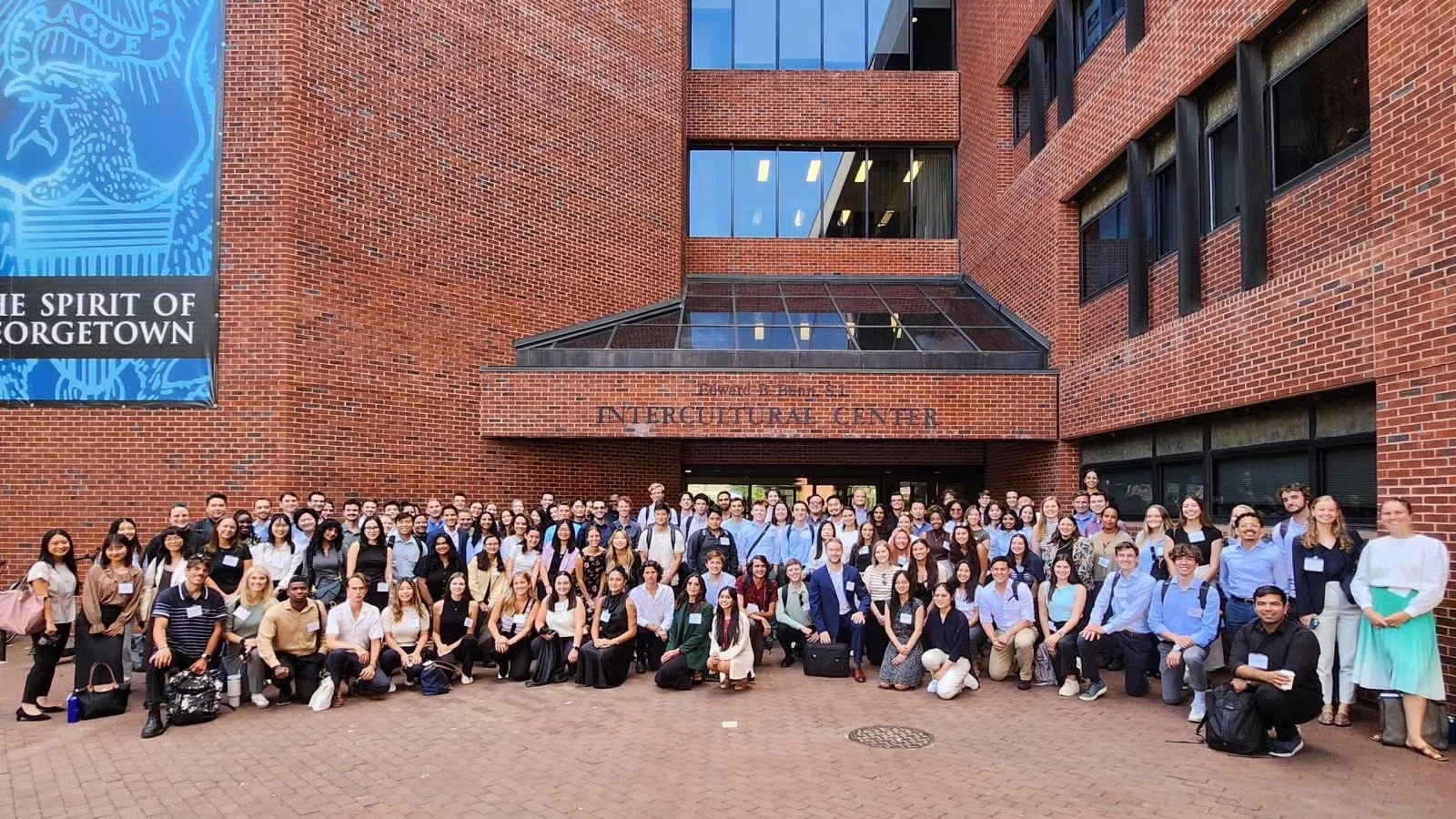
Today, SFS embodies a different reality: science and policy can no longer be treated as separate fields. Through its Science, Technology, and International Affairs program, known as STIA, Georgetown has created a space for students and faculty to explore the deliberate intersection between these areas.
This kind of approach is increasingly necessary to address the translation gap between science and policy, and the cultural gap between scientists and policymakers. These disparities are often the result of differences in communication; scientists are accustomed to handling complex, detailed information, which is often difficult for policymakers to fully understand. They’re also concerned with producing the best possible evidence, without much consideration for how policymakers might use this evidence. These gaps are further widened by differing timelines: scientific research is often a lengthy, precise process, while policy decisions frequently require urgent action.
Credit: Georgetown University
Bridging the Science-Policy Divide
We’ve seen the consequences of these gaps in recent years during the COVID-19 pandemic, when rapidly evolving scientific discoveries collided with the urgency of making policy decisions, resulting in inconsistent guidelines, widespread public confusion, and growing mistrust in health institutions. For instance, despite an impressively quick vaccine rollout, significantly fewer people received the additional booster dose, as many people were concerned about safety and long-term impacts or didn’t understand the accelerated vaccine development process. In an era when global pandemics and other environmental crises are becoming increasingly likely, STIA teaches its students how to navigate these gaps by translating scientific knowledge into accessible information and actionable policy.
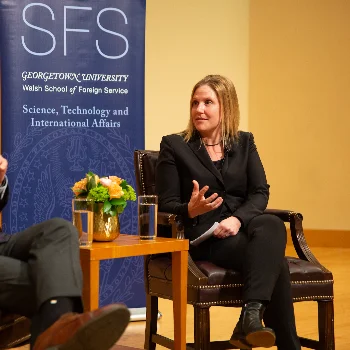
STIA is now the second-largest of SFS’s eight undergraduate majors, a sign, director Emily Mendenhall said, of the “central role of science and technology and politics.” Mendenhall, a medical anthropologist, has been part of the program for thirteen years. She also recently launched Science Politics, a publication hosted by the SFS that aims to make complex scientific, political, social, and ethical challenges accessible to a general audience through trustworthy journalism. Recent articles tackle the implications of Long COVID for patients and healthcare systems, the political potential of natural resources in Africa, and the ways evolving space technologies may threaten human rights.
Credit: Georgetown University
The Student Experience and Concentrations
“STIA is a place where you can follow your passion, and also come to things from different epistemologies and histories and try to think about how to innovate a better world,” Mendenhall said. To help students do this, the major offers five different concentrations: Energy and the Environment; Science, Technology, and Security; Biotechnology and Global Health; Business, Growth, and Development; and, most recently, Space. Each concentration requires four courses.
For senior Ana Casey, these options have allowed her to pursue her interest in environmental migration, an issue she has explored through the Energy and Environment concentration and internships in Washington, D.C., at Emerson Collective and Evergreen Strategy Group. “Everyone in STIA has a niche that they’re really interested in that you don’t often find people looking at,” she said.
The major also includes a Science Fundamentals requirement, in which students take two or three lab-based classes to develop solid foundational knowledge in a particular science subject: biology, chemistry, physics, computer science, or environmental and sustainability science. Alongside scientific training, the program emphasizes strong writing skills and the invaluable ability to translate science into policy decisions. All STIA students take a foundational course, “Science and Technology in the Global Arena,” that teaches them how to communicate scientific information to nonscientific audiences—which is directly applicable to the gap in communication and understanding between scientists and policymakers.
“STIA was actually a big part of the reason I ended up at Georgetown,” Casey shared. In high school, she was passionate about advocacy and global affairs, but she also loved her chemistry classes. “I wasn’t really ready to give up that interdisciplinary focus and experience, so I was looking for programs that allowed me to do that.”
Beyond her concentration and science requirements, Casey has enjoyed taking a wide range of STIA electives. Her favorites include her current senior seminar, “Environmental Security in the Arctic,” which she said has helped her better understand what is happening in the region amid heavy global rhetoric and media attention. She also enjoyed “Space Security and Exploration,” in which her final paper examined how methane-monitoring satellites can be utilized for climate change modeling—and even for addressing the military emissions gap.
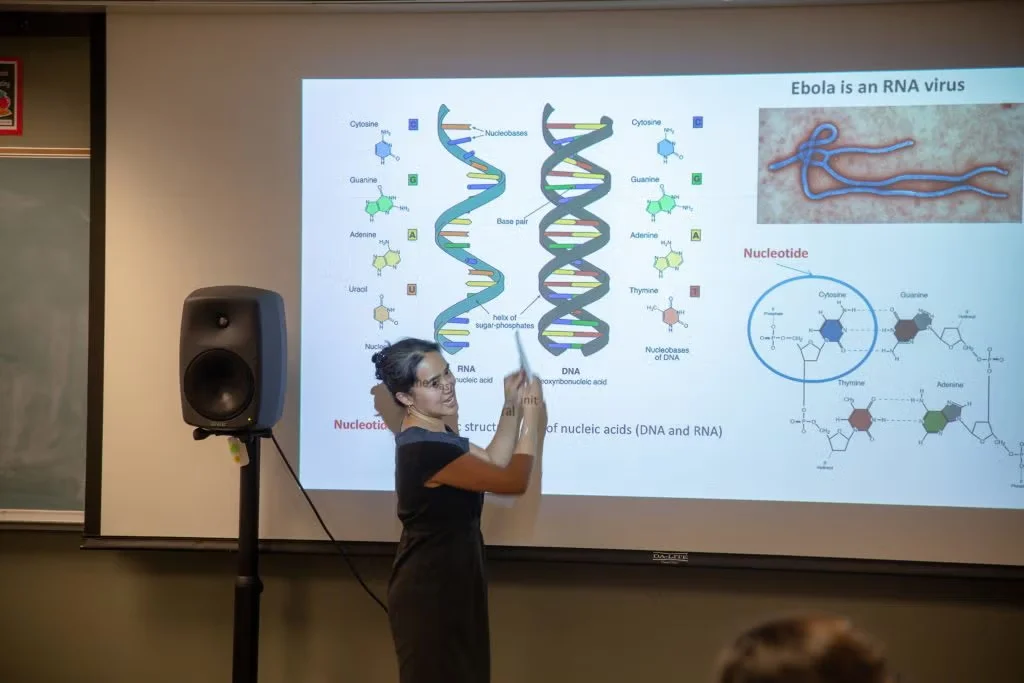
Cynthia Wei, a STIA professor and director of Georgetown’s Science for All program, has seen how deeply students value the program’s interdisciplinary focus, reflecting a growing demand for actionable science. “People are motivated by wanting to solve real challenges that matter to communities versus problems that are about basic science,” she said.
Credit: Georgetown University
Navigating an Ever-Changing World
As a biologist who studied animal behavior, Wei comes from a more traditional science background, but she began working at the intersection of science and policy after moving to D.C. She currently teaches a STIA elective called “Environmental Change: Engaging the Public with Effective Science Writing,” in which students select an environmental topic and learn to write for a variety of audiences through scientific article summaries, policy briefs, interviews, and op-eds. She particularly enjoyed teaching the timely course “COVID and the Environment” during the pandemic, which examined the impacts of the global shutdown on various environmental issues.
Wei also highlighted how STIA is uniquely positioned to engage with emerging fields at the intersection of hard science and societal challenges. These include science diplomacy, which governs international collaboration on matters such as climate change and public health, and ecological security, or the way natural resources and environmental conditions are important to a nation’s security. “STIA is a place where you can make those kinds of connections in more concrete ways,” she said. In her “Environmental Change” class, students are exploring related topics such as urban ecology, environmental education, and sustainable ocean management, examining both the underlying science and its policy implications.
With her graduation approaching in May, Casey feels that her major has prepared her well for her career and that she has already felt its benefits. “I think STIA prepares you for almost anything. I’ve been able to use it in every job and every job interview I’ve had. I think the ability to write and communicate to and for a lot of different audiences is really, really important. The ability to cut through the media noise and understand what’s at the root of science initiatives and policy initiatives is all really important.”
“I’m really proud to be part of this program,” Mendenhall said. “I think to the students and the faculty, in part because of our Jesuit values, we stand up for these strong beliefs that we hold in contributing to making the world better. And we don’t always get it right, but we can keep trying and listening and learning and evolving as a community that listens and puts people and the planet in the center. So I think that’s really a crucial part of who we are in STIA.”
In a world shaped by climate change, pandemics, and rapidly evolving technologies, that mission has become increasingly urgent. If SFS was once “safe from science,” programs like STIA show that science is no longer something to avoid—but rather a crucial field that students must learn, understand, analyze, and apply to navigate our ever-changing world.