
The Rotating Tank Harvester serves as the foundation of Algae-n-Roll, a startup founded by two researchers working across the fields of marine biology and mechanical engineering to develop a more energy-efficient and environmentally sustainable way to harvest microalgae. By employing these principles of fluid dynamics—the physics of how liquids and the particles within them move and interact—the team aims to reduce the energy demands required of algae harvesting while preserving the quality of biomass produced. Although they are small, these microalgae hold enormous potential for a variety of industries, including food production, biotechnology, and clean energy.
Earlier this year, Algae-n-Roll finished among the top ventures in GW’s New Venture Competition, competing within the Food Innovation Track. Despite this success, what is now a growing startup did not begin as an attempt to launch a business. Instead, it came from a bit of natural scientific curiosity and an unlikely collaboration between two researchers from different backgrounds.
An Unlikely Collaboration
One of the co-founders, Dr. David Fierli, arrived at GW with a background in algal biotechnology and photosynthetic cell physiology, having previously studied microalgae and their applications in fields ranging from food science to biofuel development. He soon joined the Rau Lab, an interdisciplinary research group at GW focused on fluid mechanics and marine microorganisms. There, he began looking at microalgae from a new perspective, focusing not only on the organisms themselves, but also on the physical processes of how they move and aggregate.
While studying these processes, Fierli began to recognize the transformative potential of the natural aggregation he observed. If this aggregation could be reproduced in a controlled system, it could potentially offer a completely new model for energy-efficient algae harvesting in both research and industry.
This realization ultimately led him to seek out Dr. Roberto Capanna, a researcher in GW’s Department of Mechanical and Aerospace Engineering with a considerable background in fluid dynamics. Together, the two researchers began exploring how they could transform Fierli’s algae aggregation idea into a real, engineered solution.
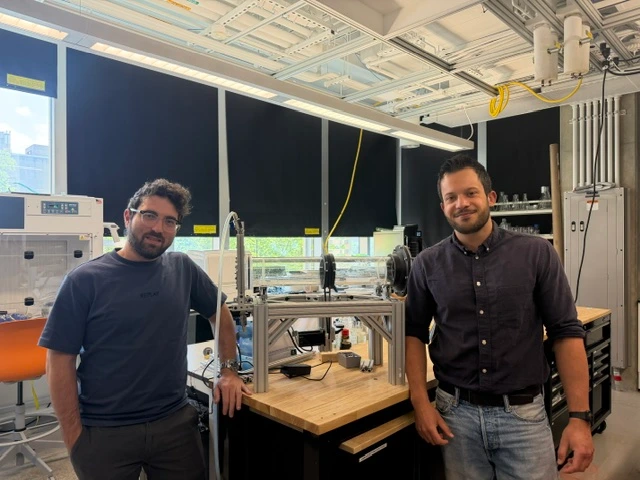
“It has been very multidisciplinary,” Fierli remarked, noting that it would have been impossible to develop this project independently. While Fierli focused on the biology of algae aggregation, Capanna focused on the fluid dynamics and mechanical design, helping to transform the team’s initial ideas into a fully functional system. Both researchers emphasized the importance of this collaboration. “I have a lot of ideas,” Fierli joked, “and Roberto is the one that makes them real.” “We are synergistic,” Capanna added.
Algae-n-Roll has since grown into an even larger collaborative effort, now involving students from different scientific disciplines as well. As a part of the team, they contribute by helping cultivate algae cultures, monitoring algae health, and optimizing the harvesting process. From Fierli and Capanna’s perspective, involving researchers from different scientific backgrounds has allowed the project to grow by bringing multiple perspectives to the table. This collaborative environment has not only been essential for refining the technology, but also for ensuring the system can be successfully adapted for larger-scale implementation beyond the laboratory.
Solving the Energy Hurdle
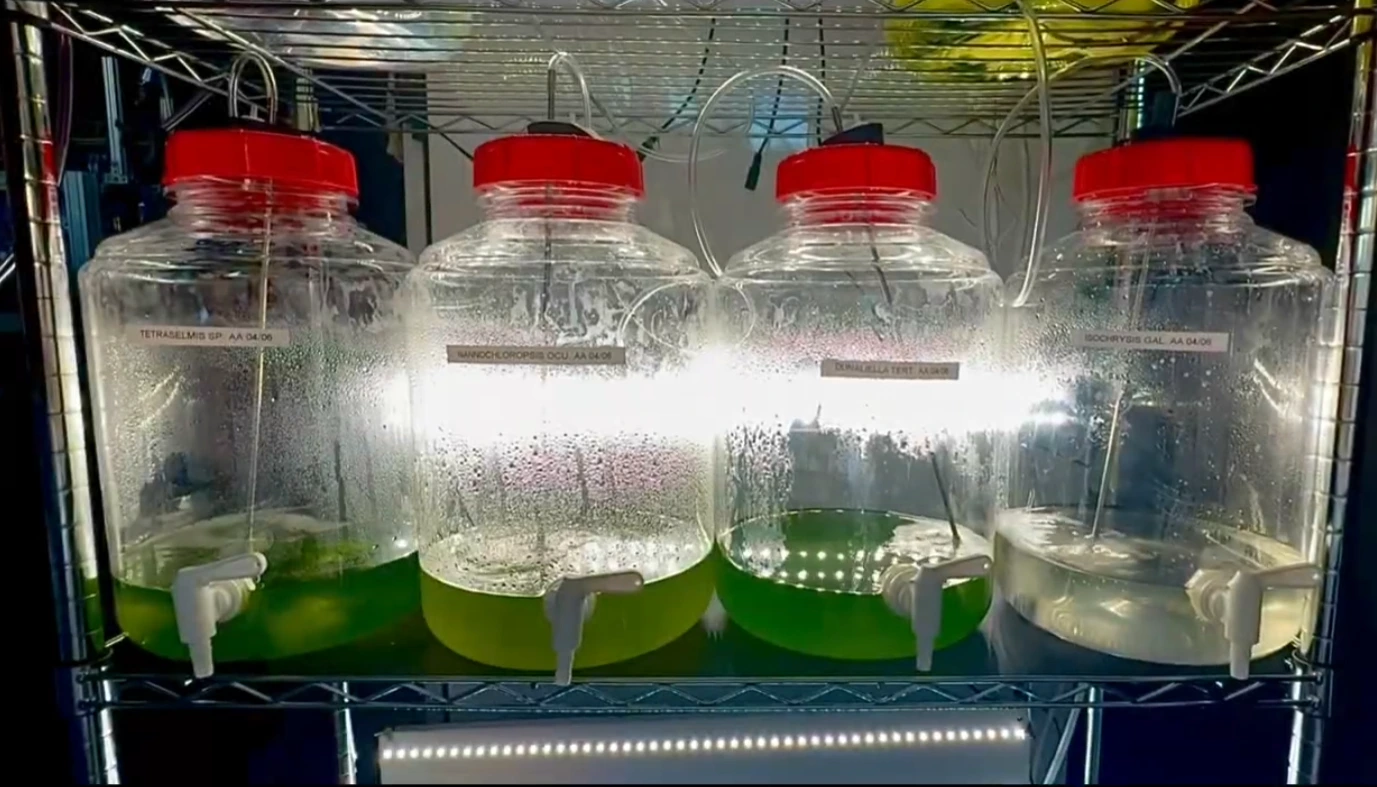
Despite microalgae being increasingly viewed as a sustainable resource, harvesting these algae is still an expensive, energy-demanding, and time-consuming process. Because the microalgae cultures are composed primarily of water, the microscopic cells have to be separated from large amounts of liquid before the biomass can be harvested and used.
Current harvesting methods typically involve high-speed centrifuges or more complex filtration systems, which both require significant amounts of energy. Chemical flocculation, which involves using chemical agents to induce this aggregation, is a cheaper and less energy-intensive method. However, the chemical additives involved can contaminate the algae, making it unsuitable for food production and other applications.
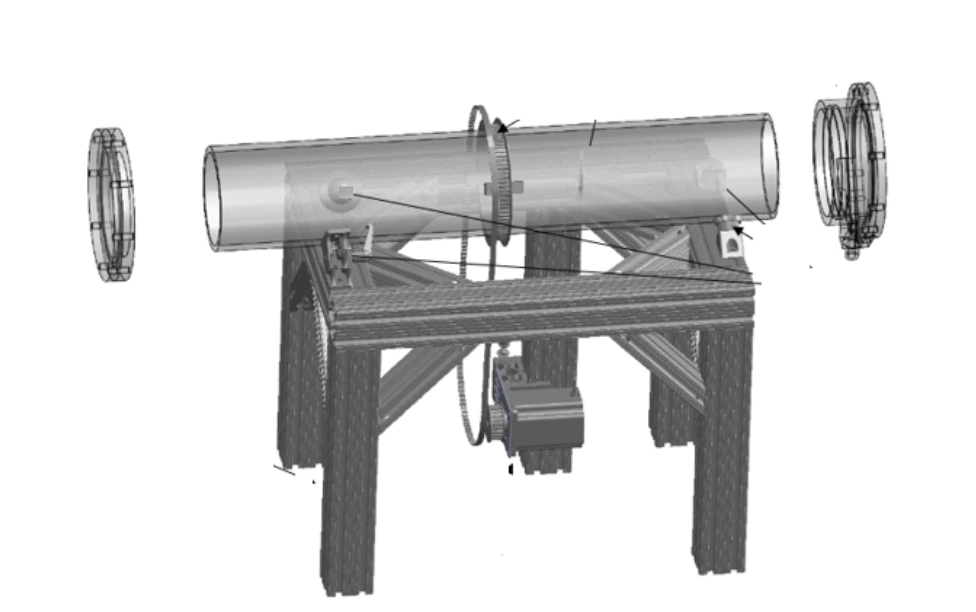
Algae-n-Roll’s Rotating Tank Harvester bridges the gaps between these existing methods by accounting for their drawbacks. Instead of relying upon chemicals or energy-intensive processes, the system uses fluid dynamics to cause the natural aggregation of cells inside the rotating cylinder. As the tank rotates, cells collide with one another and gradually form larger clusters that become easier to separate from the surrounding water. The slower rotational speeds also drastically reduce the amount of energy required compared to traditional centrifuge methods.
Physics Over Chemicals
“Flocculation uses chemicals. Aggregation is just physics,” Fierli explained.
Instead of forcing the algae apart or flooding them with chemicals, the system allows gravity and fluid motion to work together to cause aggregation inside the rotating tank.
“We make them collide together very gently,” Fierli said. “Instead of squeezing them down with brute power, we use science to make them dance gently and stay together.”
Their technology has already gone through several rounds of redesign and refinement. Although the basis of the system remained the same, the team encountered several instances of having to adjust the prototype to improve the production of algae aggregates.
“We redesigned the tank a few times to improve harvesting efficiency,” Fierli remarked.
The process of refining the system further highlighted how dependent the project was on expertise from multiple fields. Throughout the project’s development, this meant prioritizing a continued balance between biological and engineering perspectives.
“My field is biology,” Fierli noted. “His is engineering.”
“And I didn’t even know what microalgae were before he started talking to me,” Capanna added.
Looking to the Future
The current harvester design operates on a bench scale of five liters, although the team aims to scale it even further. Ideally, the next phase will involve expanding the system to 100 liters before eventually testing something closer to 5,000 liters in partnership with industry collaborators.
As Algae-n-Roll continues to grow, Fierli and Capanna expect that collaboration will remain a driving force behind the project’s progress. In addition to having engineers and biologists, the team anticipates needing expertise in areas like commercialization, industrial testing, and business development in order to successfully scale their technology. While Fierli and Capanna have experience in biology and engineering, transforming their laboratory-scale prototype into a technology that is practical and marketable is an entirely new territory. Learning how to secure partnerships, navigate the commercialization process, and communicate the value of their technology to researchers and industry professionals are some of the challenges they anticipate moving forward.
For both of the researchers, the experience has demonstrated how innovation often emerges not from individual expertise, but rather from the ability to connect ideas across disciplines. In many ways, the team’s success in the New Venture Competition reflected this same collaboration that shaped their project from the beginning.
“This multidisciplinary work would be impossible to do independently,” Fierli said. “Two of us make more than two individuals.”