
At the time of writing, three weeks ago I ran the Cherry Blossom race. I can tell you that after those Sunday long runs, I feel mentally and physically exhausted (though that might just be the dehydration speaking). To bring my perceived energy levels back up, I love drinking a Coke Zero, probably because of the flavor, the caffeine, or some other magic flavor-enhancing compound. I just get this enhanced sense of aliveness after drinking it. It makes sense; after long and strenuous physical exercise, we get thirsty. Thirst in humans is tied to a specific physiological response: your body needs water, so you seek it out. Pretty straightforward.
However, I’m not here to talk about humans. I’m personally interested in plants. Can plants get thirsty, too? How do they manage that thirst? Is there such a thing as a Coke Zero equivalent for a plant? You know how they say New York bagels have an extra kick (which I thoroughly agree with) because of the local tap water? Is there an experience like that for plants? My hope is that by the end of this article—and the next time you find yourself in a conversation about plant thirst—you’ll be able to argue that not all water is created equal, and plants definitely prefer "Salt Zero" water.
The shape of water
Plants are mostly water; in fact, in many tissues, more than three-quarters of their mass is liquid. Their entire structure relies on it, which is exactly why plants get that flabby, wilted look when they're dehydrated. They maintain their structural support through changes in cell water content and turgor pressure (water pressing against the cell walls). Shockingly, despite its insane relevance to plant structure and physiology, almost all the water a root absorbs is eventually lost to the atmosphere through transpiration. You can think of a tree as a tall bundle of leaky straws moving water from a wet reservoir (the soil) to an extremely demanding, dry reservoir (the atmosphere). But how does water actually get into and up the plant?
Interestingly, water content and volume aren't useful metrics for understanding how water moves between these different compartments. The reasoning is simple: imagine a root with 60% water content in contact with soil that only has 20% water content. Based solely on volume, you’d predict water would flow from the wet root out into the dry soil. However, roots are packed with dissolved ions and other compounds that actively draw water from the soil into the root. Therefore, instead of looking at volume, Water's 'desire' to move, or water potential is a much more useful metric.
When figuring out which direction water will flow, we always look for the compartment with the lowest water potential. Following that rule, water flows from the soil, into the plant, and ultimately out into the atmosphere. Because water is at the absolute center of plant structure, support, and function, any changes in its availability have the potential to completely reshape forest ecosystems.
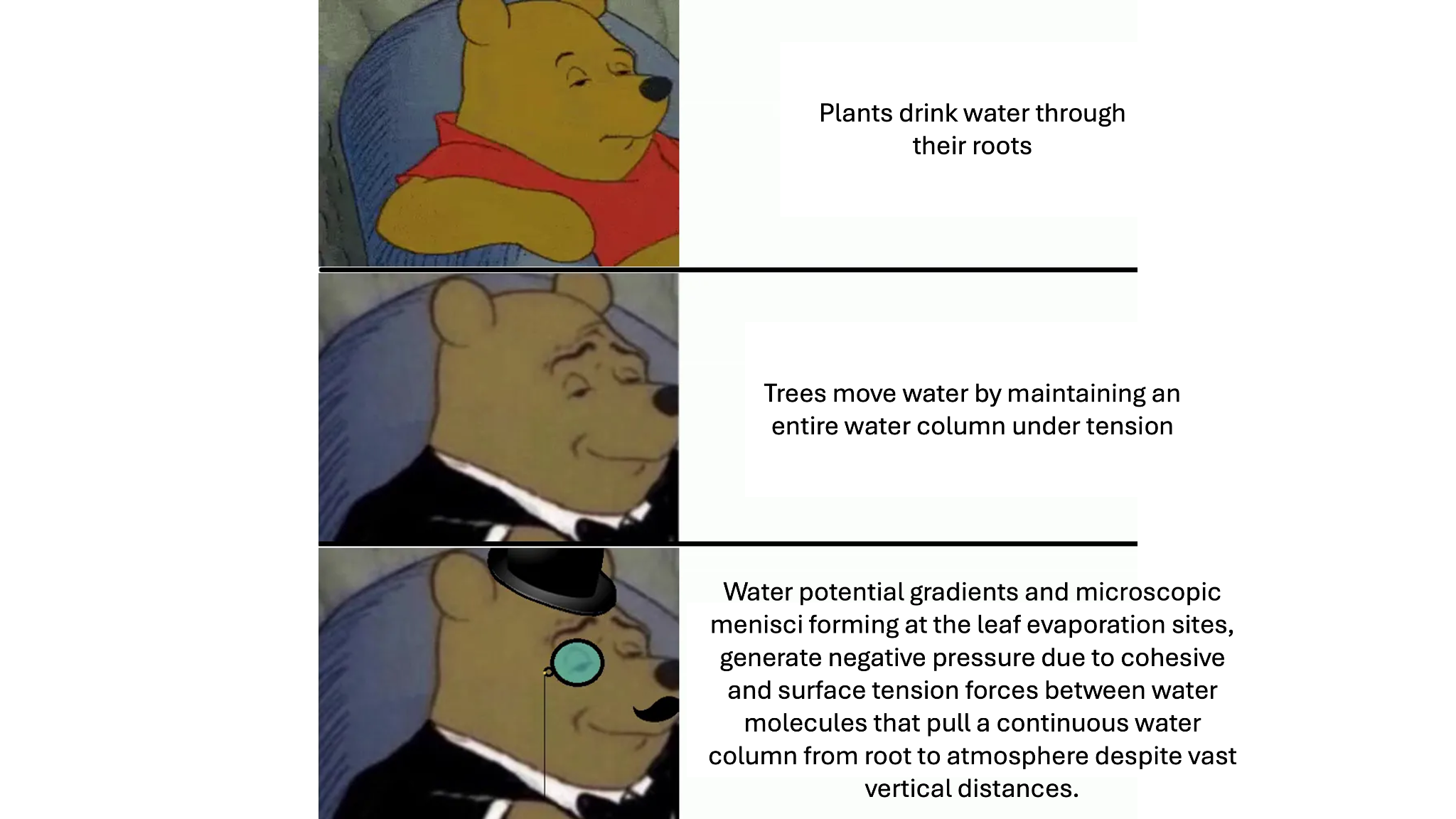
Now that we know the direction and the force of water that drives water uptake in plants, the following question is how the movement happens altogether, how do plants move water up to the leaves? Let's think this through, one solution to move water up is through a vacuum pump. However, atmospheric pressure restricts simple suction pumps to a height of roughly 10 meters. We know this is leaving out an interesting amount of trees that are taller than 10 meters, like giant sequoias. Trees move water by maintaining the entire water column that moves through those bundles of straws under tension.
The tension is generated by a microscopic curvature, a meniscus, that forms as water evaporates from the leaf. As water evaporates the depth of that curvature increases, but given the high surface tension of water, the water column tries to keep the meniscus from forming and induces the water “up” trying to break that meniscus. This cohesion of water molecules (meaning they are trying to stick and stay together) effectively pulls the water up from the soil. Consequently, as transpiration creates negative pressure at the leaf surface, the tension is transmitted through the entire column, just like a stretched rubber band. The depth of a meniscus microscopic in size pulls the water from the soil that could be more than 10 vertical meters out!

Water all around and not a drop to drink
Sea level rise is a physical process resulting from two globally influential processes: the thermal expansion of seawater (water molecules occupy more volume when heated, same thing that happens when you heat up gas, for those that remember the ideal gas law) and the melting from land-based ice that just dumps more water into ocean basins. What does it have to do with coastal forests, though? Well, the rising of sea level also alters the distance of trees to the tide line, moving saltwater further upland into places that never experienced saltwater before.
Sea level rise increases saltwater in the soil of coastal forests and also the prevalence of flooding (when the entire soil is full of water). However, this abundant presence of water in the soil is unavailable for plants. Imagine this, we went out for a run, you absolutely mogged me (been kinda cooked after a cramp on race day), we are both standing chest-deep in a pool of saltwater. Even though we’re surrounded by liquid, drinking it would actually dehydrate us faster. Remember when we talked about water potential? How we said it's a measure of water's desire to move? Saltwater really doesn't want to move, it wants water to move to it. So, even in the presence of a flooded soil (you could walk through those forests and feel the water all around you) plants are physiologically experiencing drought. They can't access that water or they might even lose water to the soil! And the main mechanism for this is just explained by differences in water potential. Water movement follows the path of least resistance.
Different flavors of thirst
Okay, but we know saltwater has a bunch of ions going around, and just like with our root example a couple of paragraphs above, we might have figured that water full of ions probably doesn't want water to move out, just like the root did. However, even in the presence of abundant freshwater (flooded freshwater conditions), plants can again experience physiological drought. Not really a meta build if you ask me. But, as always, it's not really that simple.
When the soil is fully flooded, oxygen can't diffuse as well. The coefficient of diffusion (the rate at which something moves) of oxygen in fully flooded soil conditions is 10,000 times smaller than when it's not flooded. Not only that, but the overall supply of oxygen also drops drastically. So there’s an oxygen crisis for the plant. Just like us, they need oxygen for respiration. A metabolic process that makes ATP (main energy currency for the cell) from carbohydrates (glucose, for instance). In the absence of oxygen, standard respiration cannot occur, and plants rely on non-oxygen pathways that yield much less ATP.
The non-oxygen pathways also have the production of not-so-cool metabolic byproducts, like lactate. Just like the burn in your muscles after a sprint, this lactate buildup drops the pH of the plant’s cellular fluid (cytoplasm). This acidity acts as a kill-switch, slamming shut the aquaporins (the microscopic protein channels that let water into the cells). Even with its roots submerged in a lake, the plant is effectively locked out of its own supply, dying of thirst in the middle of a flood.
To understand why a "ghost forest" stands gray and leafless on the Virginia coast, you have to look beyond the rising tide. You have to understand the physics of a microscopic meniscus, the molecular biology of a gated aquaporin, and the global chemistry of a warming ocean. The trees aren't just drowning; they are dying of a very specific, very complex kind of thirst.